

Introduction
Getting your bathroom remodel permit approved in Spring, TX is a significant milestone but it is not the finish line. In fact, permit approval is the official starting signal for one of the most important phases of your entire renovation: the multi-stage inspection process that follows. Many homeowners begin by reviewing expert bathroom remodel services to better understand how professional teams coordinate permits, inspections, and construction planning from the very beginning.
Many homeowners in Spring and surrounding Harris County and Montgomery County communities assume inspections are a quick formality a rubber stamp on the way to a finished bathroom. In reality, the inspection process is the verification system that ensures your plumbing will not leak behind walls, your electrical system will not create a fire hazard, your shower waterproofing will keep moisture out of the structure, and your ventilation will protect your home from Spring's notoriously humid climate. These are not cosmetic checks, they are structural and safety verifications that protect your investment for the life of the home. Homeowners planning locally can also explore bathroom remodeling services in Spring, Texas to see how experienced remodelers handle these project stages in real-world renovations.
Skipping or mismanaging inspections creates consequences that often surface years later during a home sale, an insurance claim, or when a hidden plumbing failure causes damage that is denied coverage because the work was never properly inspected. Understanding every inspection stage before your project starts prevents those consequences entirely. Working with experienced remodeling contractors in Spring, Texas can make the process much smoother by helping ensure permit paperwork, inspections, and construction steps are managed correctly from start to finish.
Whether you are remodeling a compact guest bath or creating a luxury primary suite with a custom tile shower and freestanding tub, this guide walks you through the complete inspection process in Spring TX, step by step, stage by stage so you know exactly what to expect from permit approval through final sign-off. Reviewing completed work such as the bathroom remodel project can also help homeowners visualize how properly planned bathroom renovations come together with quality materials, smart layouts, and code-compliant execution.
Before diving in, make sure you have already reviewed permit requirements for bathroom remodels in Spring TX and how to apply for a bathroom remodel permit in Spring TX , these lay the foundation for everything covered in this guide.
Why Inspections Matter in Spring TX
Spring TX sits across two county jurisdictions — Harris County and Montgomery County — with some properties further governed by Municipal Utility District (MUD) requirements. Depending on your exact property address, your permit and inspections will be managed through different county systems with different local code amendments. This jurisdictional complexity makes understanding the inspection process particularly important for Spring TX homeowners.
Bathroom remodel inspections are required in Spring TX whenever the work involves any of the following:
- Moving, adding, or replacing plumbing supply or drain lines
- Adding new electrical circuits, upgrading existing wiring, or installing new outlets and lighting
- Modifying structural framing — moving walls, enlarging doorways, or adding structural openings
- Installing or replacing mechanical ventilation systems including exhaust fans
- Installing a new shower pan, liner, or tiled shower enclosure
- Resizing or relocating windows in the bathroom
- Modifying load-bearing walls or structural supports
Inspectors in Spring TX verify compliance with a layered set of standards including the International Residential Code (IRC), National Electrical Code (NEC), Texas State Plumbing License Law, local county amendments, applicable energy code requirements for Climate Zone 2, and — in certain flood-zone areas — additional floodplain regulations.
The consequences of skipping inspections in Spring TX are serious and lasting:
- Failed resale disclosures — unpermitted work surfaces during buyer's home inspections and can become a negotiating liability or a condition of sale
- Insurance claim denials — water damage, fire damage, or structural claims may be denied if the underlying work was never inspected
- Fines and stop-work orders — work discovered without permits can result in county enforcement actions and required demolition
- Forced demolition — in cases where unpermitted work is discovered, demolition of finished surfaces may be required to allow retroactive inspection
- Delayed home sales — open permits or unresolved inspection violations can prevent closing or require expensive correction as a sale condition
In Spring's competitive housing market, unpermitted remodeling work is a significant red flag to buyers, buyer agents, and lenders. Understanding and completing the inspection process correctly protects your home's full market value. For a complete breakdown of all failure scenarios, read our guide on common reasons bathroom remodel inspections fail in Spring TX.
Step 1: Permit Approval — What Happens First?
Once your bathroom remodel permit is approved by the appropriate Spring TX jurisdiction — Harris County, Montgomery County, or your applicable MUD — you receive a permit package that serves as the legal authorization for construction to begin. Understanding exactly what this package contains and what it means for your project helps you start on the right foot.
Your approved permit package typically includes:
- Permit number — the unique identifier required for all inspection scheduling and communication with the county system
- Approved scope of work — a description of exactly what work has been authorized; any work outside this scope requires a permit amendment before proceeding
- Inspection schedule guidelines — information on which inspection stages are required for your specific scope and how to schedule them
- Required inspection types — the specific inspection categories that must be passed before the permit can be closed
- Permit expiration date — typically 6 months from issuance with no progress, or 1 year from issuance; work must be completed and all inspections passed before expiration or permit renewal is required
- Permit card — must be posted visibly at the jobsite from the first day of work through final inspection
At this point, construction work can legally begin. The first physical task on most projects is demolition of the existing bathroom down to the surfaces required by the approved scope. However, before scheduling any inspections, read through your permit documentation carefully to confirm which inspection types apply to your project and how your specific jurisdiction handles scheduling.
If your project scope was not clearly defined during the permit application, this is the time to clarify — before construction begins. Changes to scope after permit approval require amendments that can delay the project. For guidance on the full permit application process and how to define scope clearly from the start, see how to apply for a bathroom remodel permit in Spring TX.
Step 2: Rough-In Inspection (The Most Critical Phase)
The rough-in inspection is the single most important inspection stage in a bathroom remodel. It is the last opportunity to catch installation errors in plumbing, electrical, framing, and mechanical systems before they are permanently concealed behind drywall, cement board, and tile. Mistakes found at rough-in are relatively inexpensive to correct. Mistakes missed at rough-in and discovered after walls are closed can require complete demolition of finished surfaces — one of the most expensive scenarios in residential remodeling.
The rough-in inspection occurs after all of the following are complete:
- Demolition of the existing bathroom is complete
- All framing adjustments — wall moves, doorway changes, structural modifications — are done
- All plumbing supply and drain lines are installed in final positions
- All electrical wiring, boxes, and circuit routing are installed
- All ventilation ducts are run and connected
- Shower pan liner or waterproof membrane is installed and flood-tested
The rough-in inspection must occur before any of the following:
- Drywall or cement board installation
- Tile installation of any kind
- Insulation installation on exterior walls (unless insulation has its own separate inspection)
- Any fixture installation that conceals plumbing connections
Never install drywall or any wall covering before receiving written rough-in approval from the inspector. This is the most important rule in the inspection process — and the most costly one to violate.
Plumbing Rough-In Inspection
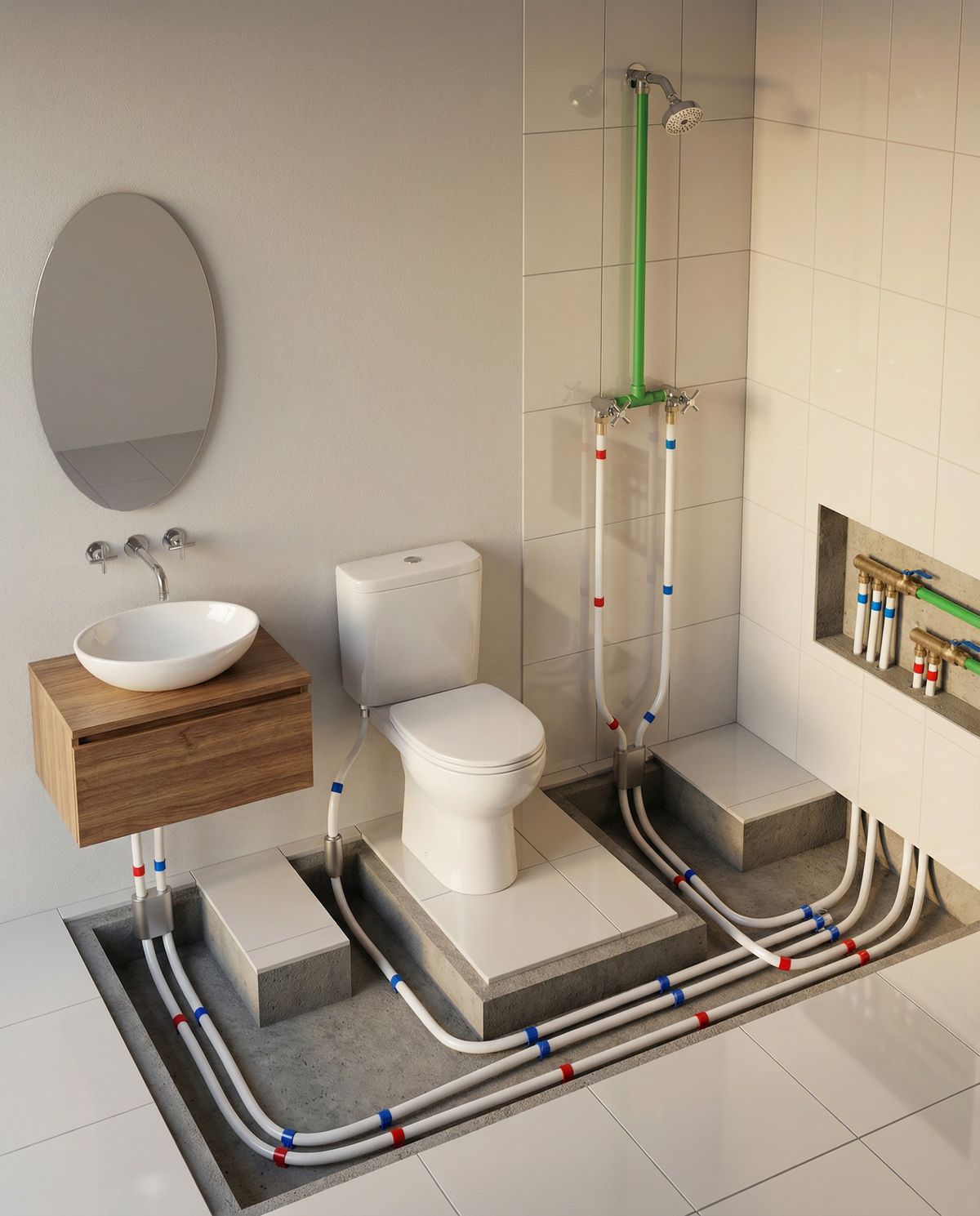
Plumbing is the most frequently failed component of the rough-in inspection in Spring TX. Inspectors check every element of the drain-waste-vent (DWV) and supply systems:
- Pipe sizing compliance — correct diameter for each fixture type (toilet 3" minimum, shower 2" minimum, sink 1.5" minimum)
- Proper slope on all horizontal drain lines — minimum 1/4" per foot for pipes ≤ 2.5", minimum 1/8" per foot for pipes ≥ 3"
- Vent stack connections — correct tie-in points, proper sizing, and correct termination above roofline
- Secure pipe fastening — pipes strapped at required intervals with approved hangers
- Pressure test results — supply lines must hold pressure without any leaks
- P-trap placement — correctly sized, correct arm length, no double-trapping or S-traps
- Shower pan liner installation and 24-hour flood test completion
- Hot supply on left, cold supply on right at all fixture connection points
- Nail plates installed at all framing penetrations within 1-1/4" of stud face
- Cleanout locations accessible and correctly placed
For the complete Spring TX plumbing code requirements that apply at rough-in, read our detailed guide on Spring TX plumbing code requirements for bathroom remodels.
Shower Pan Inspection
In many Spring TX jurisdictions, the shower pan flood test and inspection is a separate inspection call from the general rough-in plumbing inspection. This stage must be completed after the liner or waterproof membrane is installed but before any tile, mud bed, or floor substrate is applied over it.
- Drain plugged and pan filled with water to minimum 2 inches above liner height
- Water held undisturbed for a minimum of 24 continuous hours
- Zero water level drop confirmed at the 24-hour mark
- Test documented with date-stamped photos
- Inspector verifies flood test result and liner installation quality before approving tile installation
A failed shower pan inspection after tile has been placed requires complete demolition of the tile and substrate — one of the most expensive single-stage failures in bathroom remodeling. The 24-hour flood test must always be completed before tile is installed, without exception.
Electrical Rough-In Inspection
Bathroom electrical systems must meet strict NEC standards. Inspectors check every element of the rough-in electrical installation:
- Wire gauge correctness for each circuit — bathroom receptacle circuits typically require 12 AWG for 20-amp circuits
- GFCI protection at all bathroom receptacle locations — correct wiring orientation (LINE vs. LOAD terminals) verified
- Dedicated 20-amp circuit for bathroom receptacles (per NEC recommendation and local amendment requirements)
- Box fill calculations — no overcrowded junction or device boxes
- Secure wire stapling at required intervals — 12 inches from boxes, every 4.5 feet along runs
- Proper grounding at all boxes and devices
- AFCI protection where required by local NEC adoption
- Nail plates installed at all framing penetrations within 1-1/4" of stud face
- Exhaust fan switched circuit confirmed
Framing Inspection
If any walls were moved, modified, or structural framing was added as part of the remodel, the framing inspection verifies structural integrity and code compliance before walls are closed:
- Header sizing correct for all modified or new openings
- Stud spacing compliant — 16" or 24" on-center depending on wall type and load
- Load transfer path verified for modifications to load-bearing walls
- Structural reinforcement present where required
- Blocking installed at correct locations — grab bars, towel bars, shower door frames, and niche backing all require blocking in the framing stage
- Fire blocking installed at required locations
- Stud notching and drilling within code-specified limits
For Spring TX homeowners planning significant layout changes, see how we have handled structural reconfigurations in real projects through our Imperial Oaks interior layout redesign, Kingwood interior layout redesign, and Harris County room addition projects.
Mechanical / Ventilation Inspection
Exhaust ventilation is a critical inspection point in Spring TX — especially given the region's humid subtropical climate where moisture management is essential to preventing mold, insulation damage, and structural wood rot.
- Exhaust fan duct terminates to exterior — through roof cap or exterior wall cap with functional backdraft damper; never into the attic
- CFM rating meets or exceeds code minimum for the bathroom square footage
- All duct joints sealed with approved foil tape or mastic
- Correct duct diameter maintained throughout the full run
- Proper termination cap installed at exterior
For a full pre-inspection preparation checklist covering all rough-in categories, read what to prepare before rough-in inspection for bathroom remodels.
Step 3: Insulation Inspection (If Required)
If exterior walls were opened during the bathroom remodel — for plumbing relocation, window modification, or structural changes — an insulation inspection may be required before drywall installation proceeds. In Spring TX (Climate Zone 2), both R-value compliance and vapor barrier placement must meet local energy code standards.
What inspectors check at the insulation inspection stage:
- R-value compliance — insulation must meet or exceed the minimum R-value required by the applicable energy code for Climate Zone 2 exterior wall assemblies
- No compressed insulation — batt insulation that is compressed, gap-filled with torn pieces, or inadequately fitted around obstructions has a reduced effective R-value that may fail the inspection even if the correct batt size is used
- Vapor barrier placement — Climate Zone 2 vapor management requirements must be followed; incorrect vapor barrier placement can create moisture accumulation issues within the wall assembly
- Sealed penetrations — all pipe, wire, and duct penetrations through the exterior wall assembly must be properly sealed to prevent air infiltration and moisture movement
- Complete coverage — no gaps or voids in insulation coverage, including corners, edges around windows, and areas around tub and shower fixtures on exterior walls
The insulation inspection is one of the simpler inspection stages — failures are straightforward to correct before drywall goes up and are rarely as costly as rough-in or shower pan failures. However, incorrect insulation that is covered by drywall before inspection is approved creates the same demolition-and-re-inspection problem as other premature wall-closing scenarios.
Always confirm with your permit documentation whether an insulation inspection is required for your specific project scope and jurisdiction. Not all bathroom remodels that open exterior walls require a separate insulation inspection in every Spring TX jurisdiction.
Step 4: Drywall & Tile Installation Phase (No Inspection Required, But Quality Matters)
Once all required rough-in and insulation inspections are passed and approved, construction enters the finish phase. There is no official inspection at this stage — but the decisions made during finish installation directly affect whether the final inspection passes.
The typical sequence during the finish phase:
- Insulation installed (if not already done before insulation inspection)
- Drywall installed on non-wet-zone walls — standard drywall is not approved for shower or tub surround areas
- Cement board or approved substrate installed in all wet zones — shower enclosures, tub surrounds, and floor areas as required
- Waterproofing membrane applied over substrate in wet zones — coverage must be continuous at all transitions, corners, and penetrations
- Tile installed — after shower pan inspection is passed and waterproofing is complete
- Cabinets and vanities set
- Fixtures installed — toilet, sink, shower valve trim, shower door, lighting, exhaust fan cover, and all accessory hardware
Although there is no mid-phase inspection during finish work, inspectors during final inspection will evaluate the quality and compliance of finish-phase decisions:
- Correct substrate materials used in wet zones — standard drywall in a shower surround is a final inspection failure
- Caulking complete at all tile-to-fixture transitions — missing caulk at tub, shower, or floor edges is flagged at final inspection
- All junction boxes and electrical covers installed — no exposed wiring anywhere
- Fixture clearances maintained — toilet and shower minimum spacing verified visually at final inspection
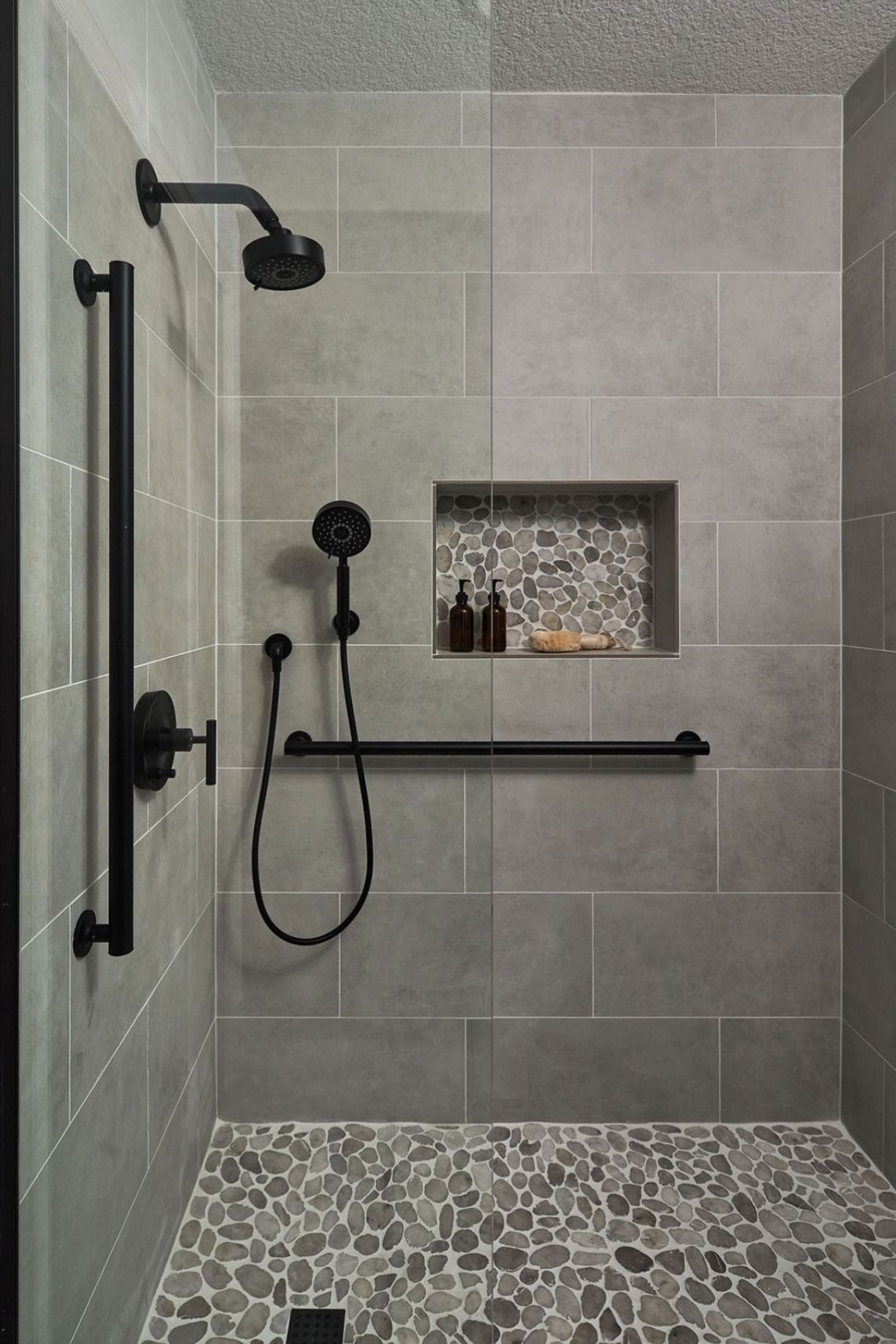
- Tempered glass used in shower enclosures and any glazed panels near the shower or tub — required by IRC for safety
For material selection guidance that helps ensure code compliance and long-term durability in Spring TX's humid climate, see our guide on choosing the right materials for humid Texas weather. For a full renovation planning framework, read our step-by-step bathroom renovation guide for 2026.
Step 5: Final Inspection (Completion Approval)
The final inspection is the last official verification before your bathroom remodel permit is closed and the project is officially complete. It occurs after all fixtures are installed, all trim and finish work is done, and the bathroom is in essentially functional, finished condition.
Inspectors do not evaluate aesthetics during the final inspection. They verify safety and code compliance only — but that verification is comprehensive. Final inspection failures are particularly frustrating because they require corrections in a nearly completed bathroom with all the access constraints of installed fixtures and finished walls.
What Inspectors Verify at Final Inspection
Plumbing Final:
- All fixtures fully secured — toilet, sink, shower, tub anchored and stable
- All connections leak-free — supply connections, drain connections, and fixture bodies checked for leaks under operating conditions
- All shutoff valves operational — supply valves under sink, behind toilet, and at shower valve all function properly
- Anti-scald (thermostatic mixing) valve installed and correctly set — shower and tub maximum temperature verified
- Cleanouts accessible — not buried behind finish materials; access panel installed where required
Electrical Final:
- All GFCI outlets tested and operational — inspectors use a GFCI tester on every outlet
- All electrical boxes have covers or plates — no exposed wiring anywhere in the bathroom
- Exhaust fan operational — confirmed running and pulling airflow adequately
- All lighting fixtures secured and operational
- All circuits correctly labeled at the panel
Mechanical Final:
- Exhaust fan verified operational with airflow moving to exterior
- Exhaust duct confirmed not terminating in attic — inspector may check attic access to verify termination point
Safety and Code Final:
- Tempered safety glass in all shower enclosures and glazed panels within 24 inches of shower or tub — required by IRC Section R308
- Fixture clearances verified — toilet centerline to wall (15" minimum), front clearance (21" minimum), shower dimensions (30" × 30" minimum)
- Caulking complete at all tile-to-fixture transitions — shower base to wall, tub deck to surround wall, floor tile to toilet base
- Door swings freely and latches properly without interference from fixtures
- All trim, escutcheons, and access covers properly installed
Once the final inspection is passed, your permit is closed — officially marking the completion of your bathroom remodel from a code compliance standpoint. Keep all inspection approvals and the closed permit documentation with your home records — you will need these at resale.
For a comprehensive guide to preparing for final inspection and avoiding the most common final-stage failures, review ways to avoid failed bathroom remodel inspections in Spring TX and common reasons bathroom remodel inspections fail in Spring TX.
Inspection Timeline in Spring TX
Understanding the realistic inspection timeline for a Spring TX bathroom remodel helps you plan the overall project schedule accurately and avoid idle days between construction phases.
Typical inspection scheduling and turnaround times in Spring TX:
- Rough-in inspection scheduling lead time: 1 to 3 business days advance notice required; inspection typically scheduled within 1 to 5 business days of request
- Re-inspection (if needed): 24 to 48 hours scheduling lead time, plus 1 to 5 business days for available appointment — total 3 to 7 business days added per failure
- Shower pan inspection: Must allow 24 hours for flood test before calling; inspection scheduled separately from rough plumbing in most jurisdictions
- Final inspection scheduling: 1 to 3 business days advance notice; typically available within 1 to 3 business days of request
Overall inspection timeline for a standard Spring TX bathroom remodel: When inspections are properly planned and all stages pass on the first attempt, the total time consumed by the inspection process is typically 1 to 2 weeks spread across the project — not in a single block, but integrated into the construction schedule between phases.
Impact of inspection failures on timeline:
- One failed inspection stage: typically adds 3 to 7 business days
- Two failed stages: typically adds 1 to 2 weeks total
- Shower pan failure after tile installation: adds 2 to 4 weeks plus material demolition and replacement cost
- Walls closed before rough-in approval: adds 1 to 3 weeks plus drywall/substrate demolition and replacement
Proper scheduling and pre-inspection preparation eliminate nearly all of these delay scenarios. For a complete guide to inspection scheduling — including how to schedule in the correct sequence, who is responsible for scheduling, and how to avoid the most common scheduling mistakes — read how to schedule bathroom remodel inspections in Spring TX.
For context on how inspection delays affect the total project budget, see the average cost of a bathroom remodel in Spring TX (2026) and factors affecting bathroom remodel costs in Spring TX.
Special Considerations for Spring TX Homes
Spring TX has specific home construction characteristics and local conditions that create additional inspection considerations beyond what applies in other Texas markets. Understanding these before your project starts prevents unexpected requirements from surfacing mid-project.
Slab Foundation Plumbing
A significant portion of Spring TX homes are built on concrete slab foundations rather than raised foundations with accessible crawl spaces. When bathroom remodels require plumbing relocation in slab-foundation homes, the process is more complex and involves additional inspection requirements:
- Concrete cutting (saw-cutting or jack-hammering) to access existing drain lines embedded in the slab
- Soil compaction verification after pipe installation to prevent post-construction settlement under the slab
- Proper backfill inspection before concrete is poured to restore the slab
- Plumbing rough-in inspection of the new pipe runs before concrete restoration
Slab plumbing work significantly increases the complexity and cost of bathroom remodels that require drain relocation. If your Spring TX home is slab-foundation and your project involves moving the toilet, shower drain, or tub drain, discuss slab work requirements with your contractor before finalizing the project scope. For additional context on how foundation type affects remodeling costs, see our guide on factors affecting bathroom remodel costs in Spring TX.
Floodplain Regulations
Portions of Spring TX fall within FEMA-designated floodplain areas, particularly near Harris County waterways. Bathroom remodels that affect the structural elements or floor elevation of homes in designated flood zones may require additional compliance documentation, elevation certificates, or floodplain administrator review beyond standard county permit requirements.
If your property is in a designated flood zone — check your Harris County or Montgomery County flood map — confirm floodplain requirements with your permit jurisdiction before finalizing project scope. Your contractor should be aware of this consideration for Spring TX properties.
HOA Requirements
Many Spring TX neighborhoods operate under Homeowner Association (HOA) guidelines that may require pre-approval for certain remodeling work — particularly exterior modifications or changes that affect shared walls in attached homes. HOA approval does NOT replace county permit and inspection requirements. Both are separate processes and both must be completed.
Submit HOA approval requests early — HOA review timelines are independent of county permit timelines and delays in HOA approval can push the project start date even if the county permit is ready. Confirm HOA requirements before applying for permits, not after.
Harris County vs. Montgomery County Jurisdiction
Because Spring TX spans two county jurisdictions, the applicable permit office, inspection scheduling system, local code amendments, and inspector contacts vary by specific property address. Working with a contractor who regularly operates in Spring TX — and who has experience with both county systems — eliminates the risk of applying to the wrong jurisdiction and experiencing permit delays. Our permit requirements guide for Spring TX explains how to determine your specific jurisdiction.
Inspection Fees in Spring TX (2026 Estimate)
Most standard inspection visits in Spring TX are included within the original permit fee rather than charged separately. However, re-inspection visits after failed inspections carry additional fees, and some jurisdictions charge for inspections beyond the standard included number. Understanding the fee structure helps you budget accurately and appreciate the real cost of failed inspections.
- Plumbing inspection: Typically included in the overall permit fee
- Electrical inspection: Typically included in the overall permit fee
- Framing inspection: Typically included in the overall permit fee
- Shower pan / waterproofing inspection: Typically included in the permit fee for projects that include a tiled shower
- Final inspection: Typically included in the overall permit fee
- Re-inspection fee (failed inspection): $50 to $150 per re-inspection visit depending on jurisdiction and inspection type
- Additional inspection visits beyond included count: May incur fee per the county fee schedule — confirm with your specific jurisdiction
- Permit amendment fees: If scope changes after permit approval require plan amendment, additional fees apply based on the change magnitude
The re-inspection fee itself ($50–$150) is the smallest component of the true cost of a failed inspection. The larger costs are correction labor, contractor rescheduling charges, material waste from required demolition, and project timeline extension. For a complete picture of how unexpected costs — including inspection failures — affect total bathroom remodel budgets in Spring TX, see our guides on the average cost of a bathroom remodel in Spring TX (2026) and factors affecting bathroom remodel costs in Spring TX.
Final Thoughts
The inspection process that follows permit approval in Spring TX is not a bureaucratic obstacle designed to slow your project. It is the verification system that confirms your family's safety, protects the structural integrity of your home, prevents costly future repairs, preserves your home's resale value, and ensures your investment was built to code.
Each inspection stage rough-in, shower pan, insulation, and final serves a specific purpose and catches specific categories of installation errors while they are still accessible and correctable. When you approach each stage with proper preparation, the inspection process becomes a series of routine sign-offs rather than stressful milestones.
The key to a smooth inspection process in Spring TX is the same as the key to a successful bathroom remodel overall: preparation, correct sequencing, and working with licensed professionals who understand local code requirements and inspector expectations. Whether you are managing a focused guest bathroom upgrade or a full primary suite transformation, the inspection process is manageable when approached correctly from the start. Homeowners researching local remodeling professionals can also view our location and project presence at Home remodeling & construction in The Woodlands while planning their upcoming renovation.
Choosing the right contractor matters. Reach out to Remodeling contractors The Woodlands & nearby areas like Spring, Conroe, Tomball, and Magnolia.