

Introduction
Bathroom remodeling in Spring, Texas is one of the most valuable upgrades you can make to your home. A well-executed bathroom remodel adds daily comfort, modernizes your living space, and meaningfully increases resale value. But before you choose tile, vanities, and fixtures, there is something far more important to understand: plumbing code compliance.
In Spring TX which spans portions of both Harris County and Montgomery County plumbing work during a bathroom remodel must follow strict local, county, and state regulations. Failing to meet code requirements can result in failed inspections, costly rework, permit delays, insurance complications, and future resale issues that surface during a home sale. For complex plumbing, waterproofing, and inspection requirements, many homeowners work with expert bathroom remodeling professionals who understand how code compliance affects both safety and long-term durability.
Understanding what the code requires before demolition begins is not just about avoiding penalties — it is about protecting your investment for the long term. This is especially true in Spring's humid subtropical climate, where plumbing failures, moisture intrusion, and poor waterproofing create damage that compounds quickly. Homeowners planning renovations in this area often consult experienced remodeling contractors in Spring, Texas to review plumbing layouts, waterproofing strategies, and inspection requirements before construction begins.
This 2026 homeowner guide breaks down everything you need to know about Spring TX plumbing code requirements for bathroom remodels from permit triggers and fixture clearances to drain sizing, venting, waterproofing, and inspection stages.
Working with professionals who understand local code requirements protects your project from start to finish. Our team at Remodeling services for Bathroom in Spring TX handles all permit applications, plumbing coordination, and inspection scheduling as part of every project.
Which Plumbing Code Does Spring TX Follow?
Spring TX generally follows the Texas State Plumbing License Law and the International Plumbing Code (IPC) as adopted and amended at the county level. Because Spring is an unincorporated community rather than a standalone city, the applicable jurisdiction depends on your specific property address — either Harris County or Montgomery County — and in some cases, your Municipal Utility District (MUD) may impose additional requirements.
Key points about plumbing code authority in Spring TX:
- All plumbing work must comply with the Texas State Plumbing License Law and adopted IPC standards
- Licensed master plumbers or journeymen under supervision are required for all permitted plumbing work
- Rough-in inspections are mandatory before walls can be closed
- Final plumbing inspections are required after fixtures are installed
- Harris County and Montgomery County may have different amendment details — confirm your jurisdiction before starting
- Some MUD districts require additional inspections or documentation beyond county requirements
Even seemingly minor plumbing changes — like relocating a shower drain by 12 inches or swapping a single vanity for a double — may require full code compliance, permits, and inspections. Never assume scope is too small to require a permit without confirming with your local authority.
For a broader look at what triggers permits and how to navigate the Spring TX permitting process, see our guide on permit requirements for bathroom remodels in Spring TX.
When Is a Plumbing Permit Required?
In Spring TX, a plumbing permit is required for any work that involves new pipe installations, relocations, or connections to the existing drain-waste-vent (DWV) or supply systems. The following scope items almost always require a plumbing permit:
- Moving or rerouting water supply lines (hot or cold)
- Replacing, rerouting, or adding drain or vent lines
- Adding new plumbing fixtures (sinks, toilets, showers, tubs)
- Converting a tub-only configuration to a shower or combination unit
- Installing a new shower pan, liner, or prefabricated shower base
- Upgrading from a single vanity to a double vanity requiring new drain connections
- Changing water heater connections or relocating the water heater
- Installing a bidet, smart toilet, or other specialty fixture with new connections
- Any work on shared walls that contain supply or drain lines for adjacent bathrooms
What typically does NOT require a plumbing permit: purely cosmetic updates such as replacing a faucet or showerhead in the same location, swapping a toilet for a new model on the same rough-in, or replacing a vanity top without moving drain connections. However, even these should be confirmed with your local jurisdiction before proceeding.
Skipping a required permit is one of the most costly mistakes a homeowner can make. Unpermitted plumbing work can trigger stop-work orders, required demolition to expose work for inspection, insurance claim denials, and complications at resale. For a full breakdown of when permits are and are not required, read permit requirements for bathroom remodels in Spring TX and learn how to apply for your bathroom remodel permit in Spring TX.
Minimum Fixture Spacing Requirements
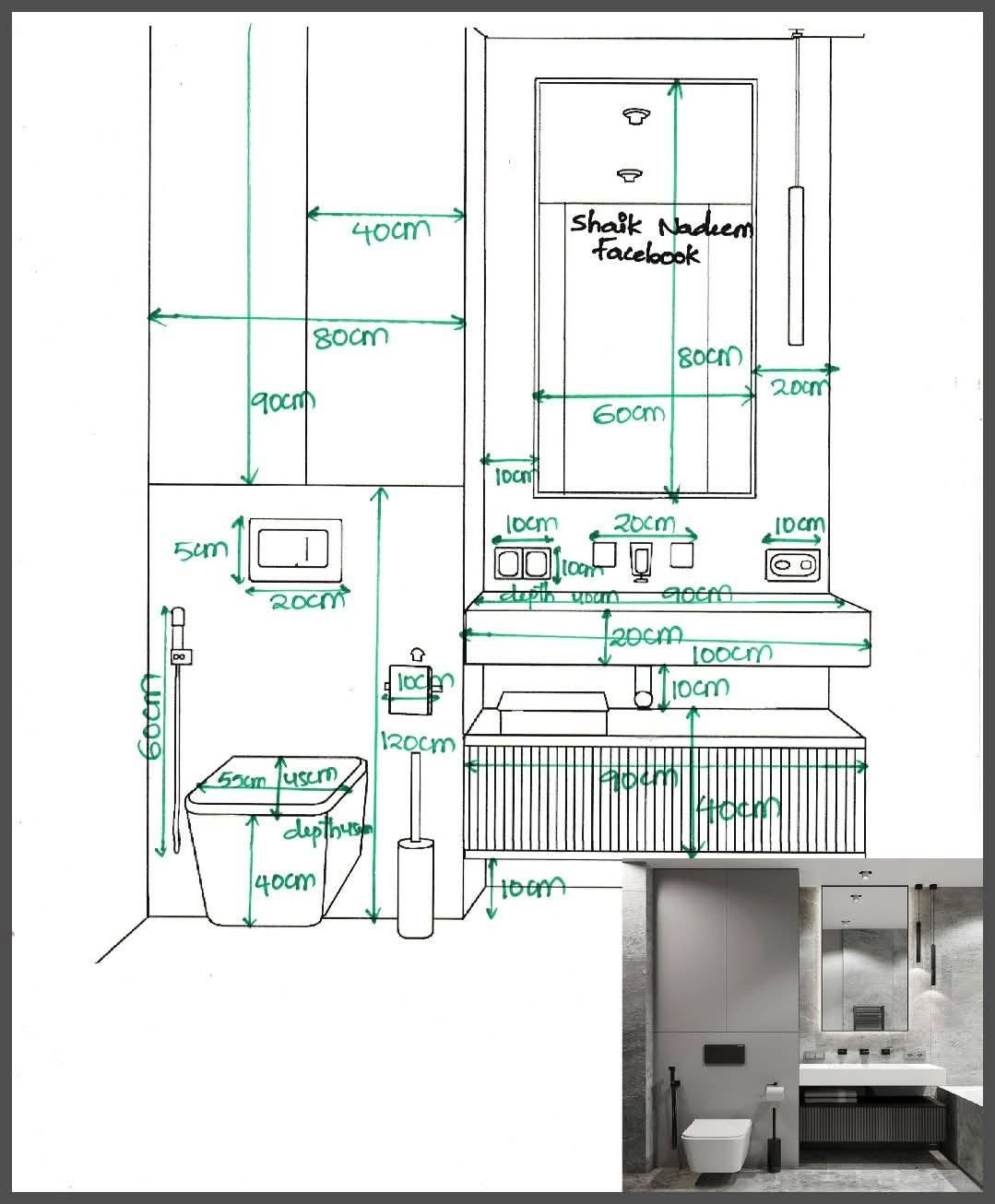
Fixture spacing requirements are among the most commonly failed items during bathroom remodel inspections in Spring TX. These minimums are established by the IRC and IPC and enforced during both framing and final inspections. Failing to meet spacing requirements means physical rework — moving walls, relocating fixtures, or reconfiguring layout — all of which adds significant cost after the fact.
Toilet Clearance Requirements
- Minimum 15 inches from the centerline of the toilet to any side wall, cabinet, or fixed obstruction
- Minimum 21 inches of clear floor space in front of the toilet (measured from the front of the bowl to any opposing wall or fixture)
- ADA-compliant layouts require 18 inches from centerline to side wall and 60 inches of front clearance — relevant if aging-in-place features are planned
Shower Requirements
- Minimum interior shower dimension of 30 inches × 30 inches per IRC
- Must allow a 30-inch diameter circle to fit inside the shower floor area
- Minimum ceiling height of 6 feet 8 inches within the shower area
- Shower door swing must not interfere with fixture use in the bathroom
Bathtub Requirements
- Proper P-trap installation at the tub drain with accessible clean-out or serviceable connection
- Approved overflow fitting connected to drain system
- Mandatory anti-scald valve (thermostatic mixing valve) required by code
- Structural support (blocking) in framing for grab bars if installed or planned
Vanity and Sink Clearances
- Minimum clearance between sink centerlines in double-vanity configurations
- Cabinet door and drawer swing must not conflict with toilet or shower door operation
- Under-sink plumbing must remain accessible for future serviceability
Improper spacing is one of the most common reasons bathroom inspections fail in Spring TX — especially in smaller guest bathrooms and powder rooms where every inch matters. Planning fixture layout carefully before framing begins prevents rework that can add thousands of dollars to your project cost.
If you are planning a full renovation and want to understand how layout decisions affect both code compliance and long-term livability, our step-by-step bathroom renovation guide for 2026 walks through the planning process in detail. You can also see how we have handled layout challenges in real Spring-area projects through our Imperial Oaks interior layout redesign and Oak Ridge North bathroom remodel projects.
Drain & Waste Line Requirements
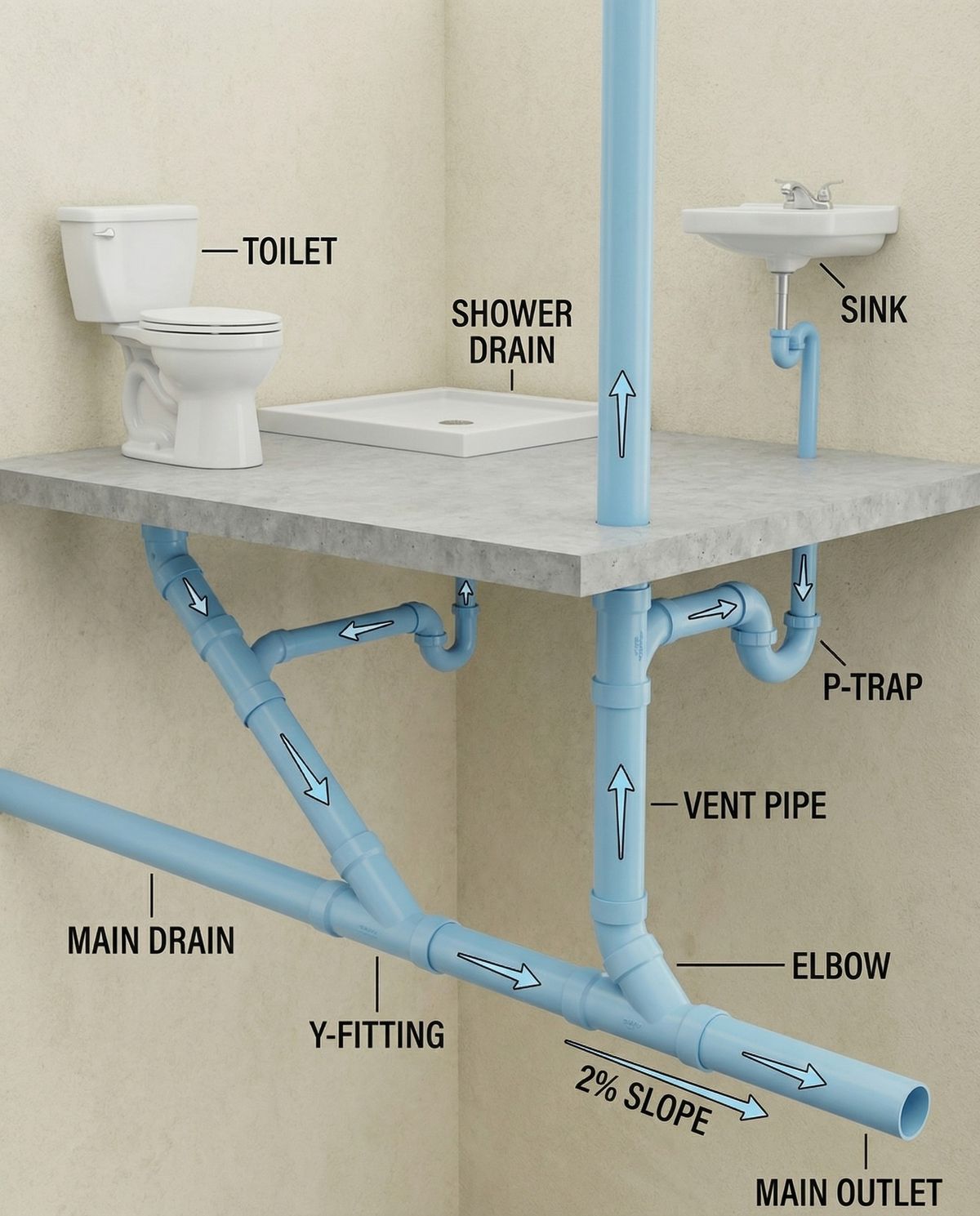
Drain and waste line requirements are the area where the most plumbing code violations occur in Spring TX bathroom remodels. Inspectors check pipe sizing, slope, trap placement, and cleanout access at the rough-in stage — and any of these being non-compliant is enough to fail inspection and require rework before walls can be closed.
Pipe Sizing Requirements
- Toilet drain: 3-inch minimum diameter — no exceptions
- Shower drain: 2-inch minimum diameter
- Bathtub drain: 1.5-inch minimum diameter (2-inch preferred for better flow)
- Lavatory (sink) drain: 1.5-inch minimum diameter
- Combined drain lines: must be upsized based on total fixture unit load per IPC tables
Proper Drain Slope
Drain lines must maintain a consistent downward slope to ensure gravity-fed drainage and prevent standing water, clogs, and sewer gas buildup. The IPC and Texas State Plumbing Code specify:
- A minimum slope of 1/4 inch per foot for drain pipes 2.5 inches in diameter or smaller
- A minimum slope of 1/8 inch per foot for drain pipes 3 inches and larger
- Slope must be consistent — sagging or humped pipe runs are flagged during inspection
- Horizontal drain runs must be supported at required intervals to maintain proper slope
P-Trap Requirements
- Every fixture must have a properly sized P-trap located as close to the fixture as practicable
- No double-trapping — a single fixture cannot have two traps in series
- Trap arm length must stay within code-specified limits based on pipe diameter
- S-traps (vertical trap arms) are not permitted under IPC
Cleanout Requirements
- Cleanouts required at the base of all vertical stacks
- Accessible cleanouts required at specific intervals in horizontal runs
- Cleanouts must remain accessible after walls and floors are finished — plan access panels where needed
Improper drain slope is particularly damaging in Spring TX's humid environment — standing water in drain lines accelerates corrosion, creates chronic odor problems, and attracts pests. Getting slope right during rough-in is far less expensive than diagnosing and repairing drain problems years later.
For a full picture of what happens during the rough-in inspection stage, see what to prepare before rough-in inspection for bathroom remodels and the full inspection process after bathroom remodel permit approval in Spring TX.
Venting Requirements
Plumbing venting is one of the most misunderstood and most frequently violated areas of bathroom remodel code compliance in Spring TX. Every plumbing fixture must be properly vented — without adequate venting, trap seals are siphoned away, allowing sewer gases (including toxic hydrogen sulfide) to enter the living space. Poor venting also causes slow drainage, gurgling drains, and recurring odor problems.
Core Venting Requirements
- Every fixture trap must be connected to an approved vent system to maintain trap seal integrity
- Vent pipes must extend through the roof or connect to an approved vertical stack that terminates above the roofline
- Vent pipe must terminate at minimum 6 inches above the roof surface
- Vent terminations must be kept away from windows, doors, and air intake openings
- Air admittance valves (AAVs) may be permitted in certain applications — confirm with your local jurisdiction
Wet Venting Rules
Wet venting — where a single pipe serves as both drain and vent for multiple fixtures — is permitted under the IPC but must follow strict sizing rules:
- Wet vent pipe must be sized based on total fixture unit load, not just the largest single fixture
- Fixture connections to wet vents must be at or above the centerline of the wet vent pipe
- Toilet fixtures connected to wet vent systems have specific limitations — confirm with your plumber
Exhaust Fan Venting (Mechanical Ventilation)
In addition to plumbing venting, Spring TX code requires bathroom exhaust fans to vent moisture to the building exterior — never into the attic. Venting into the attic is one of the most commonly flagged violations during bathroom remodel inspections and creates serious long-term damage including mold growth, insulation failure, and structural wood rot.
- Exhaust fan duct must terminate through an exterior wall cap or roof cap with a functional damper
- All duct joints must be sealed with approved foil tape or mastic — not standard duct tape
- Correct duct diameter must be maintained throughout the full run — no reducing fittings that restrict flow
- Minimum CFM rating required based on bathroom square footage per IRC mechanical provisions
Improper venting in Spring TX's humid climate is especially damaging. Moisture that cannot properly escape accelerates mold, wood rot, and material failure throughout the bathroom structure. For additional guidance on how ventilation choices affect long-term maintenance, see our article on choosing the right materials for humid Texas weather.
Venting violations are a primary reason DIY bathroom remodels fail inspection in Spring TX. Licensed plumbers who work regularly in this jurisdiction understand exactly how local inspectors verify vent configurations — an area where cutting corners is never worth the risk.
Shower Pan & Waterproofing Code
Shower waterproofing is strictly regulated in Spring TX bathroom remodels — and for good reason. A failed shower liner or improperly installed pan membrane is one of the most expensive hidden failures in residential construction. Water that migrates through the shower floor or walls damages subfloor, framing, and adjacent walls — often invisibly for months or years before the damage becomes obvious.
Shower Pan Liner Requirements
- Shower liner must be a code-approved material — PVC, CPE, or hot-mopped asphalt depending on method used
- Liner must extend a minimum of 2 inches above the top of the shower curb on all sides
- The shower floor substrate must be properly pre-sloped toward the drain at a minimum 1/4 inch per foot
- Corner folds must be properly executed — improperly folded corners are a primary source of liner failures
- Liner must not be punctured by fasteners — fasteners used above the flood line only
- Drain assembly must be compatible with the liner type and allow water to pass through the weep holes
The 24-Hour Shower Pan Flood Test
Before any tile, cement board, or floor covering is installed, the shower pan waterproofing must pass a mandatory 24-hour flood test. This is a required inspection stage in Spring TX — not optional.
- Plug the drain with an approved test plug rated for the drain size
- Fill the pan with water to a minimum of 2 inches above the highest point of the liner
- Allow water to sit undisturbed for a full 24 hours minimum
- Confirm zero water level drop at the end of the test period — any drop indicates a leak
- Inspector must verify the test result before tile installation can begin
Failure of the shower pan flood test after tile has already been installed requires complete tile and substrate removal, liner repair or replacement, and a full retest before the project can continue. This is one of the most expensive mid-project failures in bathroom remodeling — and it is entirely preventable with proper installation technique and material selection.
Waterproof Membrane Systems (Alternative Methods)
Modern sheet-applied and liquid-applied membrane systems — such as Schluter KERDI, Laticrete Hydro Ban, and RedGard — are permitted alternatives to traditional PVC liner systems in many Spring TX jurisdictions. These systems must be installed per manufacturer specifications and may require documentation at inspection.
Approved Substrate Materials in Wet Zones
- Cement board (HardieBacker, Durock, or equivalent) is the standard substrate behind tile in shower and tub surrounds
- Fiberglass mat gypsum board (DensShield or equivalent) where specified and approved
- Standard paper-faced drywall is not approved in direct wet-zone applications — this will fail inspection
- Moisture-resistant drywall ("green board") is approved only in low-splash areas — not inside shower or tub surrounds
For a deeper dive into what inspectors check at the shower pan stage and how to prepare, read our guide on what to prepare before rough-in inspection for bathroom remodels and ways to avoid failed bathroom remodel inspections in Spring TX.
Inspection Requirements
Bathroom remodel plumbing inspections in Spring TX follow a specific sequence. Skipping an inspection stage or proceeding to the next phase of construction before receiving approval can result in required demolition to expose work, re-inspection fees, and significant project delays.
Rough-In Plumbing Inspection
The rough-in inspection takes place after all new pipe runs, drain connections, supply lines, and vent configurations are complete but before any walls are closed or substrates installed. Inspectors check:
- Correct pipe sizing for all fixtures based on fixture unit calculations
- Drain slope verified at all horizontal runs (1/4" per foot minimum for lines ≤ 2.5")
- Vent connections verified — proper tie-in points, stack sizing, and termination
- Pressure testing on supply lines (typically hydrostatic test)
- P-trap placement and arm length compliance
- Cleanout locations verified and accessible
- Pipe strapping and support intervals confirmed
- Nail plates installed where pipes pass through framing within code-specified distance of stud face
Walls cannot be closed until the rough-in inspection is passed and approved. This is a hard rule — closing walls before inspection approval requires full removal for re-inspection.
Shower Pan Inspection
The shower pan flood test is a separate inspection stage that occurs after the liner or membrane is installed but before any tile or substrate is placed. The 24-hour flood test result must be verified by the inspector before tile installation can begin. See the Shower Pan & Waterproofing Code section above for full test procedure details.
Final Plumbing Inspection
The final plumbing inspection occurs after all fixtures are installed, trim work is complete, and the bathroom is in essentially finished condition. Inspectors verify:
- All fixtures are fully secured and leak-free
- No visible leaks at supply connections, drain connections, or fixture bodies
- All shutoff valves operate properly
- Cleanouts remain accessible — not buried behind finish materials
- Anti-scald valve (thermostatic mixing valve) properly installed and set
- All plumbing trim (escutcheons, covers, access panels) properly installed
- Water heater connections compliant if modified during project
For the complete multi-stage inspection sequence including electrical, framing, and final sign-off, see our guides on how to schedule bathroom remodel inspections in Spring TX, the inspection process after permit approval, and the most common reasons bathroom remodel inspections fail in Spring TX.
Final Thoughts
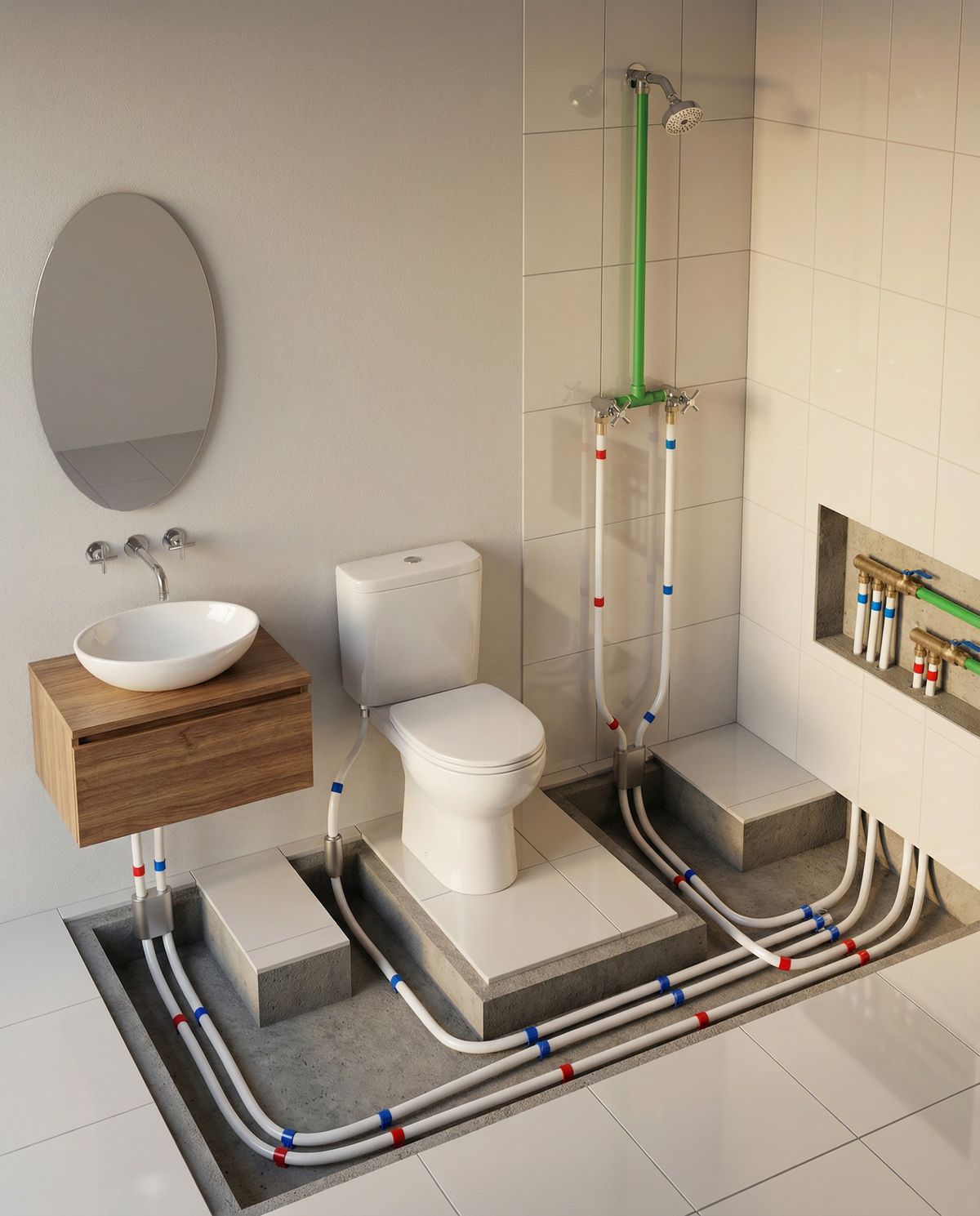
Bathroom remodels are far more than cosmetic upgrades. Behind every tile wall is a complex, interconnected system of drainage, venting, water supply, pressure regulation, and waterproofing that must function correctly for the life of your home. When any part of that system is installed incorrectly — even subtly — the damage compounds quietly until it becomes a major, expensive repair.
Plumbing code compliance in Spring TX protects four critical interests: your family's health and safety, the structural integrity of your home, the value of your remodeling investment, and your home's resale value. Inspections are not obstacles — they are the system that verifies these protections are in place.
If you are planning a bathroom remodel in Spring, Texas, make plumbing code compliance part of your strategy from day one — not an afterthought when problems arise mid-project. The most cost-effective time to get plumbing right is during rough-in, before a single tile is set.
When you are ready to start your Spring TX bathroom remodel with a team that handles permits, plumbing coordination, inspections, and code compliance from day one, or reach us directly through our contact page. You can also reach out to trusted professional remodeling contractors, to read client reviews, and get directions . .
Choosing the right contractor matters. Reach out to Remodeling contractors The Woodlands & nearby areas like Spring, Conroe, Tomball, and Magnolia.