

Introduction
If you are comparing a sunroom vs patio enclosure in Texas, the right choice depends on what you want the space to do for your home. Some homeowners want a lower-cost way to enjoy the backyard with more shade, fewer insects, and better protection from rain. Others want a brighter, more finished space that feels more like an extension of the house. That is where the difference between a patio enclosure and a sunroom becomes important.
A patio enclosure is usually the better fit when your priority is budget, faster construction, and improved outdoor living. A sunroom is usually the stronger choice when your priority is comfort, a more enclosed room-like feel, and a more premium finished result. In Texas, that decision matters even more because heat, humidity, sunlight exposure, storms, and long warm seasons all affect how usable the space will be after the project is finished.
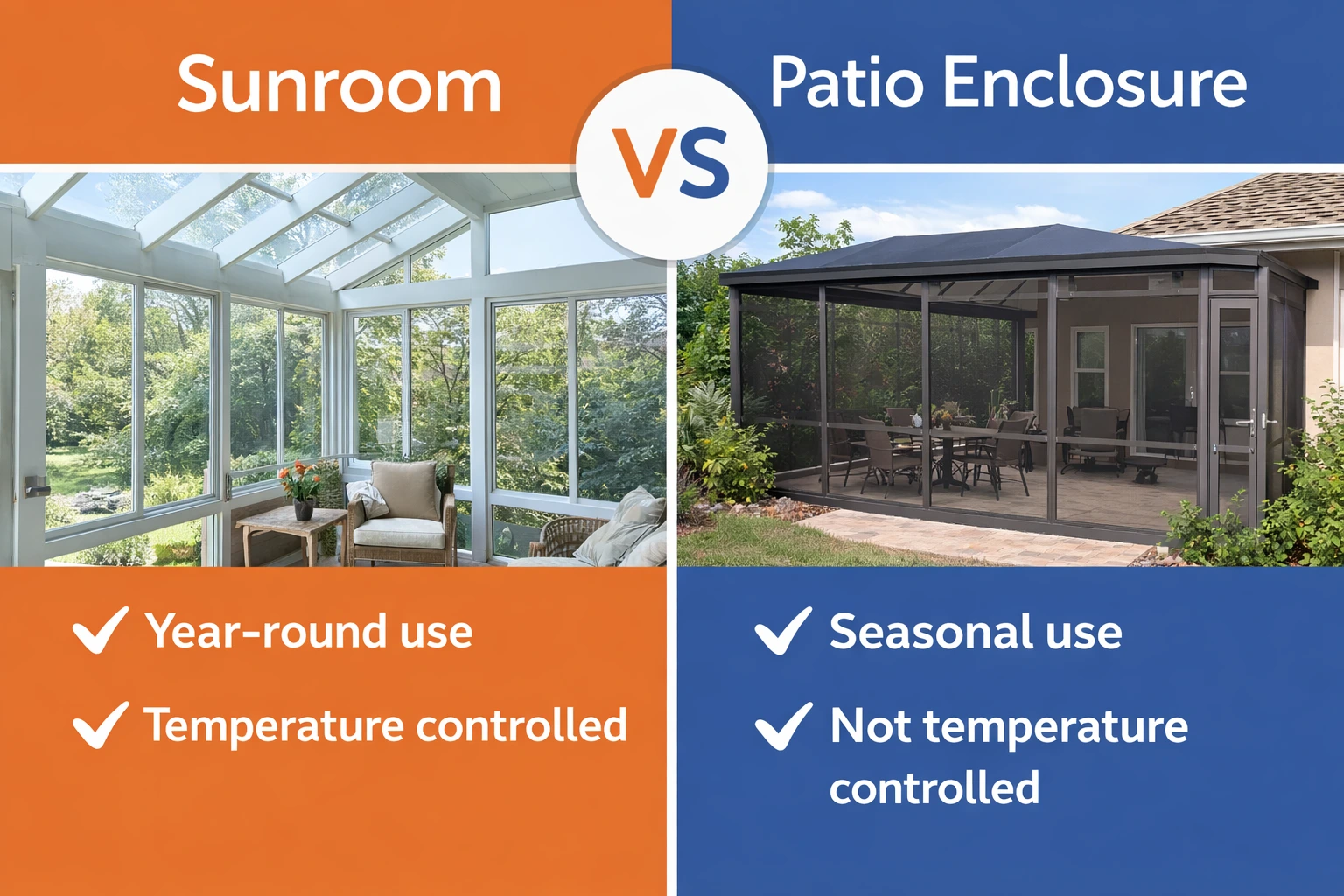
For homeowners trying to rank the real pros and cons, the short answer is this: a patio enclosure often gives better short-term value if you mainly want to upgrade an existing patio, while a sunroom generally gives a better long-term result if you want the new space to feel integrated with the home. The best option is not the one with the more impressive name. It is the one that matches your budget, your comfort expectations, and how often you plan to use the space.
Homeowners exploring either option alongside other exterior or outdoor upgrades may also find it useful to review our guide on designing outdoor living spaces, it covers how sunrooms, enclosures, and outdoor zones can be planned together rather than as isolated decisions.
What Is the Difference Between a Sunroom and a Patio Enclosure?
The main difference is how the space performs once it is built.
A patio enclosure usually starts with an existing patio or covered outdoor area and improves it by enclosing it more fully. It still tends to feel connected to the outdoors, even when it offers better protection from insects, wind, and rain. It is often the more practical option for homeowners who already have a patio footprint and want to make it more usable without taking on the cost of a more room-like addition.
A sunroom is usually a more substantial enclosed space with a stronger interior feel. It is often brighter, more finished, and better suited for daily use as a sitting room, dining area, reading room, or flexible family space. In many cases, a sunroom also involves better glazing, more insulation, more finish work, and a higher overall level of integration with the house.
So when homeowners search "sunroom or patio enclosure which is better", the more accurate answer is that a patio enclosure is better for simpler outdoor-living improvement, while a sunroom is better for homeowners who want a more complete living-space upgrade. For a full breakdown of sunroom types and which performs best in Texas conditions, see our dedicated guide on sunrooms in The Woodlands, TX (2026).
Sunroom vs Patio Enclosure Cost in Texas
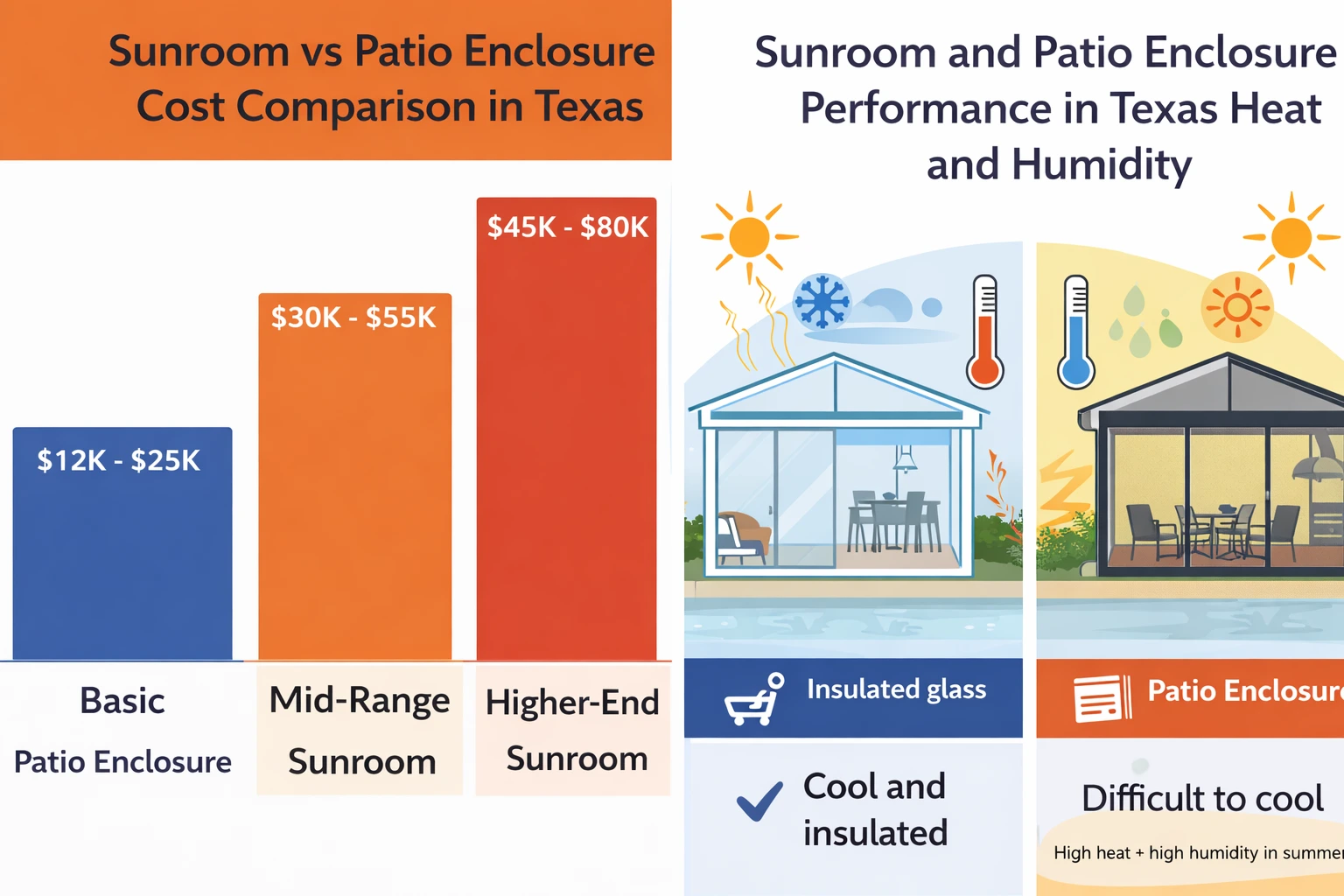
Cost is usually the first thing homeowners compare, and it is also where expectations often need to be adjusted. A patio enclosure is usually more affordable because it often works from an existing slab or patio structure and may not require the same finish level, insulation level, or structural integration. A sunroom usually costs more because the project is closer to building a finished room than simply enclosing a patio.
Below is a planning-level cost table you can use as a realistic framework.
| Project Option | Typical 2026 Installed Cost Range | Budget Position | Typical Use Case |
|---|---|---|---|
| Patio Cover | Lower than enclosed options; varies by size and materials | Lowest | Adds shade and weather cover but does not create a true enclosed room |
| Basic Patio Enclosure | $150–$300+ per sq. ft. | Lower | Improves patio usability with more protection from bugs and weather |
| Mid-Range Sunroom | $250–$450+ per sq. ft. | Mid | Creates a more enclosed and more comfortable space for regular use |
| Higher-End Sunroom | $400–$700+ per sq. ft. | Higher | Delivers a more finished, room-like space with the strongest comfort potential |
A patio enclosure is generally the better answer when someone searches "cheaper alternative to a sunroom in Texas". A sunroom is usually the better answer when someone searches "is a sunroom worth the extra cost".
The cost gap exists because sunrooms often require more work in several areas. The structure may need stronger framing, more finished walls or ceiling details, higher-grade windows or panels, better thermal performance, more electrical work, and more refined interior finishing. A patio enclosure can still become expensive, but it usually starts from a lower point because it is often a simpler project.
For a broader view of how addition and enclosure costs compare across different project types in this area, see our guide on home addition cost in The Woodlands, Conroe & Magnolia and our overview of home additions in Texas: expanding your home to fit changing needs.
Is a Sunroom Worth More Than a Patio Enclosure?
For homeowners asking "does a sunroom add more value than a patio enclosure", the answer is usually yes, but only when the room is designed well and built to feel like part of the home.
A sunroom often feels more substantial to both homeowners and future buyers. It can function as a true lifestyle upgrade rather than just a patio improvement. It may be used as a breakfast room, secondary sitting room, reading lounge, or flexible entertaining area. Because of that, it often carries more perceived value.
A patio enclosure can still be an excellent investment, especially when it solves a practical need without overspending. If your main goal is making the backyard more usable, a patio enclosure may actually provide better value for the amount spent. The return is often strongest when the space aligns with how the family already lives. If you mostly want better use of your patio, an enclosure may be the smarter financial decision. If you want a new finished living zone, a sunroom is often worth the added cost.
Homeowners planning either project alongside other upgrades may find it useful to compare ROI across categories. Our guide on exterior enhancements, outdoor care, and home exterior upgrades covers how outdoor-facing projects fit into the broader picture of property value in Texas.
Which Option Is Better for Texas Heat, Rain, and Humidity?
Texas weather changes the answer significantly. A patio enclosure may work very well when your main need is shade, rain protection, and fewer insects. But when temperatures climb and the sun sits heavily on the back of the house, a more enclosed space with stronger protection from heat often becomes much more useful.
That is why many homeowners searching "best room addition for Texas weather" lean toward a sunroom when they want regular daily use. A A sunroom generally performs better when comfort is a priority, especially when designed with proper insulation and smart layout planning. For homeowners evaluating layouts that actually work in Texas humidity, see our guide on best sunroom designs for humid Texas weather (2026), which breaks down what designs stay cooler and more usable year-round. It can provide better separation from outdoor temperature swings and more protection from humidity, pollen, and heat buildup when built using materials aligned with ENERGY STAR window performance requirements.
A patio enclosure still works very well in Texas when the homeowner wants a casual outdoor-living upgrade rather than a true room addition. If you mainly want a better sitting area for mornings, evenings, or mild-weather days, a patio enclosure can be the more practical and cost-effective choice.
For a deeper look at how Texas heat and humidity affect building materials across different project types — including enclosures and additions — see our guides on eco-friendly remodeling options for Woodlands homes surrounded by nature and energy-efficient remodeling ideas for The Woodlands homes. Both cover material performance in humid Southeast Texas conditions.
Do You Need a Permit for a Sunroom or Patio Enclosure in Texas?
One of the most common search questions is "do I need a permit for a patio enclosure or sunroom in Texas?" In most cases, homeowners should assume that some level of permit or approval may be required, especially when the work changes the structure, adds a roofed enclosure, or creates a more substantial addition-like space.
For homeowners in areas like The Woodlands, this matters even more because The Woodlands Township permit requirements often apply alongside county permitting depending on the scope. The more enclosed, permanent, and structurally integrated the project becomes, the more likely it is that drawings, Residential Design Review Committee approval, and inspections will be part of the process.
From a practical standpoint, a patio cover is often the simplest path, a patio enclosure is more involved, and a sunroom is usually the most documentation-heavy option.
Homeowners in Montgomery County should be especially aware that Montgomery County addition permit requirements apply broadly to roofed structures and additions. For a specific look at how permitting works for larger enclosures and structural work in this area, see our guide on drywall installation in Montgomery County — which covers how county approval processes apply to structural interior and exterior work — and our broader overview of sunroom permits and approvals in The Woodlands.
How Long Does It Take to Build a Sunroom or Patio Enclosure?
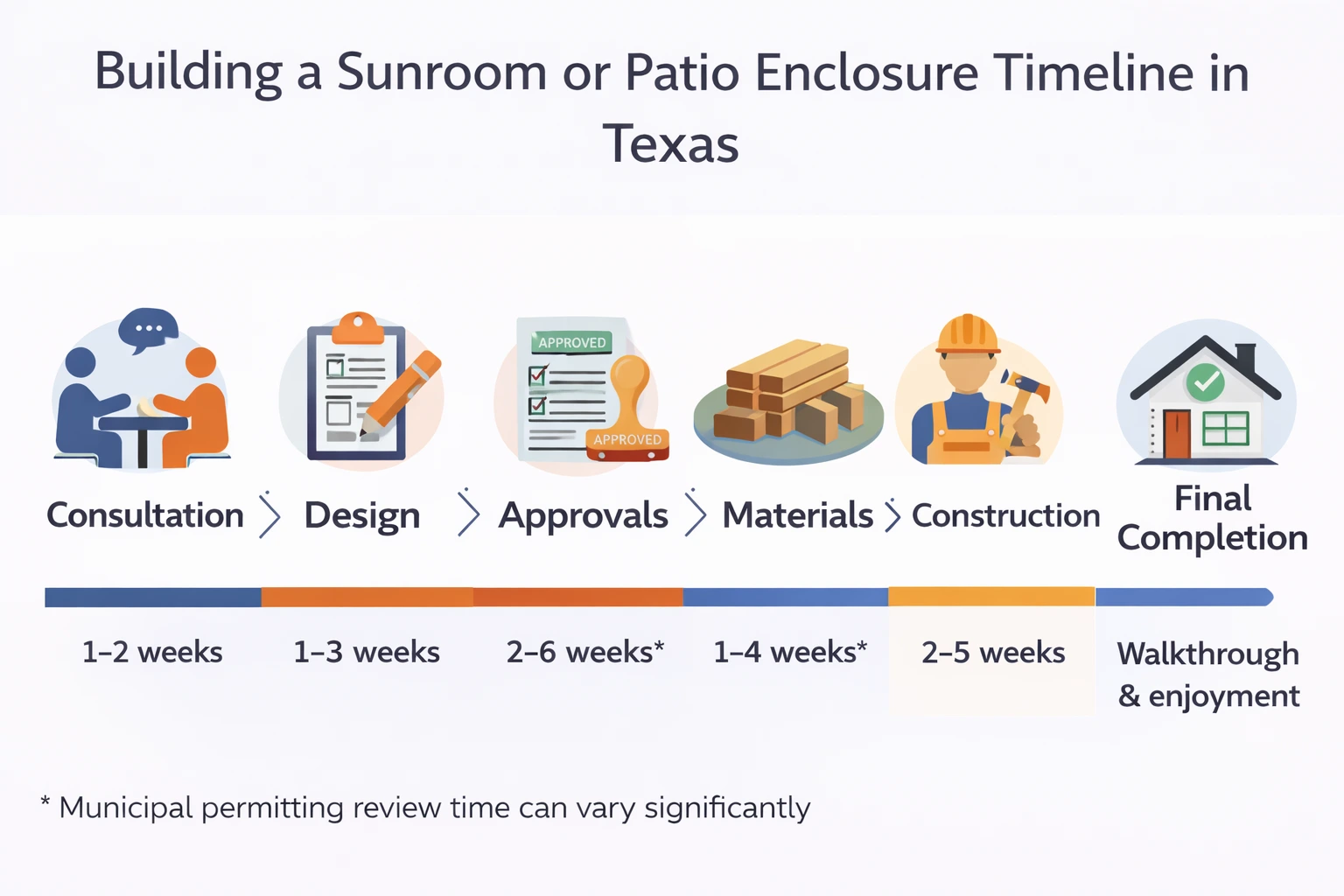
Homeowners also search "how long does a sunroom take to build" and "how long does a patio enclosure take" because timeline affects both convenience and cost. In general, a patio enclosure is faster. A sunroom usually takes longer.
A patio enclosure often moves faster because it is usually a simpler structure with fewer finish layers and less systems coordination. A sunroom often takes more time because it involves more design work, more detailed material selection, more finishing, and in many cases more approval coordination.
The full process usually starts with an on-site evaluation. That includes measuring the space, reviewing the existing patio or slab, checking roof tie-in conditions, looking at drainage and sun exposure, and understanding how you want to use the new area. After that, the design and scope are finalized. Then the project moves into submission and approvals where required, followed by material ordering and construction.
| Project Type | Typical Timeline | Main Timeline Drivers |
|---|---|---|
| Basic Patio Enclosure | Faster — often a few weeks once approved | Simpler structure, fewer finish layers, less systems coordination |
| Three-Season Sunroom | Moderate — several weeks including approvals | More finish work, material ordering, design coordination |
| Four-Season Sunroom | Longer — often 6–12+ weeks end to end | Full insulation, HVAC, electrical, approval documentation, slab work if needed |
From a homeowner's perspective, the simplest way to think about it is this: if you want the faster option, a patio enclosure usually wins. If you want the more finished and room-like option, expect the sunroom to take longer but deliver a more complete result.
Is a Patio Enclosure Better for Budget-Conscious Homeowners?
For homeowners searching "most affordable way to enclose a patio in Texas", the patio enclosure is often the stronger answer. It usually gives you the biggest improvement in usability without requiring the budget of a more advanced sunroom project.
This is especially true when:
- you already have a solid patio slab,
- the existing patio layout works well,
- your goal is to improve comfort rather than create a full new room,
- and you want a project that feels practical rather than luxury-focused.
A patio enclosure makes the most sense when you want to solve real outdoor-living problems without overbuilding. It can make the backyard more enjoyable, improve how often the patio is used, and create a much more comfortable place to sit and entertain.
For homeowners managing a tighter remodeling budget across multiple projects, see our guide on designing outdoor living spaces — it covers how to prioritize outdoor upgrades so the budget goes toward what will be most used, not just what sounds most appealing.
Is a Sunroom Better for Daily Use and Long-Term Enjoyment?
For homeowners searching "is a sunroom better than a patio enclosure for everyday use", the answer is usually yes. A sunroom generally delivers more comfort, more enclosure, and more flexibility for year-round use.
That matters because many homeowners initially think they only want a simple patio upgrade, but later realize they want the space to function more like a true room. That is where the sunroom becomes the better fit. It can feel more finished, more private, and more connected to the rest of the home. It also tends to support more types of use, from quiet morning coffee to family seating, casual dining, remote work, or entertaining.
If you expect to use the space frequently and want it to feel more like interior square footage, a sunroom is usually the better long-term choice. The layout and glass configuration make a major difference here, which is why many homeowners review sunroom design options suited for Texas weather before finalizing their project scope.
Homeowners who want a sunroom that connects naturally to an updated interior — including improved natural light, ventilation, and comfort — may also benefit from reviewing our guide on daylight, views, and comfort in healthier interior spaces, which covers how light and airflow design decisions affect daily livability across different room types.
Should You Choose a Sunroom or Patio Enclosure for Resale Value?
When homeowners search "which adds more resale value sunroom or patio enclosure", the answer usually depends on how well the project fits the house.
A poorly designed sunroom can feel out of place and may not justify its extra cost. A well-designed sunroom, however, often feels like a meaningful property upgrade. A patio enclosure may cost less and still improve appeal, especially if it solves obvious issues with an underused patio or outdoor space.
So the better resale strategy is not automatically "build the bigger project." It is "build the right project." If the home needs a more finished living transition space, a sunroom is often stronger. If the home already has enough interior living space and simply needs a better outdoor zone, a patio enclosure can be the smarter move.
For homeowners thinking about resale across the full property, see our guide on exterior enhancements and outdoor care upgrades for a broader view of which outdoor-facing projects tend to support buyer appeal most effectively in the Texas market.
Why Homeowners in Texas Often Choose a Patio Enclosure First
Many Texas homeowners begin with a patio enclosure because it solves immediate issues at a lower cost. It helps with insects, shade, and weather. It also usually requires less investment and may be completed faster than a more advanced room addition.
This makes it attractive for homeowners who want a noticeable improvement without taking on a major remodel. In many cases, it is the right first step because it aligns with how the space will actually be used. Not every home needs a full sunroom. For some properties, a patio enclosure is the best balance of price and practicality.
Homeowners who want to prioritize practical outdoor improvements before larger interior remodeling projects may also find it useful to review our guides on Energy Star home upgrades in The Woodlands, TX and energy-efficient kitchen remodeling in Texas — both cover how to sequence upgrades so each investment builds on the last.
Why a Sunroom Is Often the Better Upgrade for Comfort
When comfort is the main goal, a sunroom usually wins. It feels more complete, more enclosed, and more adaptable. It also tends to feel more intentional architecturally when designed correctly.
That is why searches like "best enclosed room addition for backyard in Texas" often point homeowners toward a sunroom. It supports more everyday uses and often creates a more polished transition between the house and the backyard. For homeowners who want a space they will use frequently and in more ways, a sunroom often becomes the better long-term decision.
For a full look at sunroom types, costs, permit requirements, and design considerations specific to the Houston area, see our comprehensive guide: sunrooms in The Woodlands, TX: cost, design & ROI (2026 guide).
Why Texas Homeowners Work With Us for Sunrooms and Patio Enclosures
Homeowners do not just need a contractor. They need a team that understands the difference between a project that looks good in photos and a project that actually works in Texas conditions. We approach sunrooms and patio enclosures based on how the finished space will perform, how it will connect to the house, and whether it is the right fit for the property rather than simply recommending the larger option every time.
We look at the existing patio or backyard structure, roof tie-in conditions, sunlight exposure, drainage, layout, and how the homeowner really wants to use the space. That matters because the right answer is not always the same. Some homes benefit far more from a practical enclosure that improves outdoor living at the right budget. Others need a more finished and integrated sunroom to deliver the comfort and function the homeowner expects.
Our focus is to build a space that feels intentional, suits the house, and gives real day-to-day value. That means helping homeowners avoid overspending on the wrong scope while also avoiding underbuilding a project that later feels too limited. The result is a space that works better, looks better, and makes more sense for the home.
To explore more of how we approach outdoor-living additions and enclosures, visit our guide on designing outdoor living spaces or contact our team to discuss your sunroom or patio enclosure project directly.
Choosing the right contractor matters. Reach out to Remodeling contractors The Woodlands & nearby areas like Spring, Conroe, Tomball, and Magnolia.